

MAVA Colleagues,
We are pleased to share this piece from today’s “Enterprise”.
I found it to be a very enjoyable account of the success of a young recent Brockton High graduate. It is just a small example of the impact educators make every day on the future lives of their students.
Today is not the best of weather days, but I hope your day is productive and enjoyable.
Trust you will be attending the upcoming MAVA Retreat in Devens. It is certain to be a powerful professional development experience and an opportunity to spend time with your MAVA colleagues.
David
Here’s why a robotics firm founder hired Brockton students on the spot
Jacob Posner The Enterprise July 30, 2026
- Julian Melendez, a recent Brockton High graduate and the team’s pilot, helped win a national drone competition.
- Interns at the company, GreenSight, are developing a "marsupial drone" for various applications.
- Melendez plans to study Aviation Maintenance Technology and later seek a job that will fund an engineering degree.
BOSTON — When Joel Pedlikin, co-founder of a robotics company based in Charlestown, met members of Brockton High School’s drone team in 2024, he decided to hire some of them on the spot as paid interns.
“First of all, they were clearly extremely smart, and had worked hard and learned a lot about drones, especially for kids their age,” he said. “Second of all, as you talk to them, you definitely get the feeling that they have not had the level of support and networking that, say, an upper-middle class white kid from Lexington or Winchester would have.”
Pedlikin said he and his co-founder believe in providing talented young people opportunities in robotics.
Julian Melendez, who just graduated from Brockton High in 2026, is an intern this summer. He was the pilot for the high school drone team when it won first place at a national competition this year.
The four other summer interns at the company, called GreenSight, are there through the Jumpstart Fellowship, which provides opportunities for women in STEM.
<![if !vml]>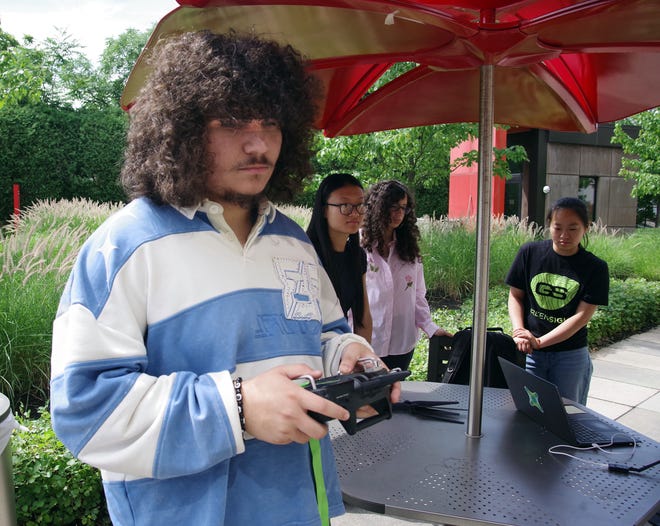 <![endif]>Melendez becomes excellent drone pilot
Melendez, soft spoken and curly haired, sat for an interview on a couch in a corner of the office, a high-ceilinged space with lots of plants, walls decorated with drones and a view of the Bunker Hill monument.
He became involved in the drone team between eighth grade and the start of high school, after his mom saw an ad on Facebook for a summer program. When the team was figuring out who would be pilot his sophomore year, it turned out he had an aptitude for drone flight.
Cedric Turner, founder of the nonprofit that runs the drone team at Brockton High, said Melendez’s piloting skills are a big reason Brockton won the national title this year.
Melendez said, “I used to play a lot of video games as a kid, so maybe that was kind of like a template for it. But I’m not too sure how I became this, uh, this good pilot that everybody calls me.”
<![if !vml]> <![endif]>‘Marsupial drone’
One day in July, Melendez and his co-interns were clustered around a small table, their laptops open to a computer-assisted design software.
They aren’t just there to do busywork. Last summer, they contributed to a product GreenSight actually built for a customer. The interns had been tasked with designing a “marsupial drone, which means a small drone that flies on a bigger one and takes off from it," Pedlikin said.
GreenSight took the interns’ basic blueprint and modified it for a construction company, which needed to figure out why a drainage tunnel had collapsed while they were building it. The space was too small for a normal-sized drone, Pedlikin said, and the tunnel too long for a smaller drone to traverse before running out of battery.
<![if !vml]> <![endif]>
This summer, Pedlikin said the interns are developing a more sophisticated version of the marsupial drone, which also has uses in the defense industry.
Melendez pulled up an image of a drone that looked like a small airplane on his laptop. The interns had ordered one, and were going to try to rig it to deploy two, smaller drones, he said.
"A lot of military has transferred over to the fixed wings," said Lillia Ivaniv, an intern sitting nearby, "because they use less power. So they can fly for much longer times than a quadcopter can."
‘I’m not some rich guy’
<![if !vml]>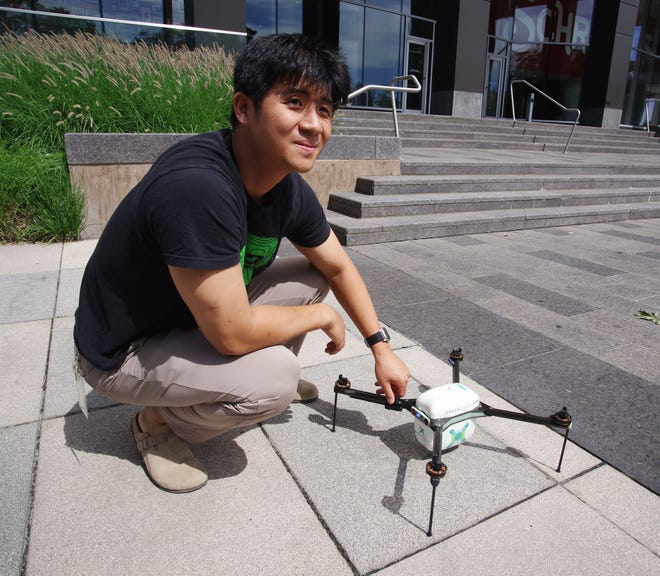 <![endif]>
The day The Enterprise visited, the interns went to the plaza outside their office to test the marsupial drone from last summer. The goal is for it to operate on autopilot, and they had to make sure the computer and flying machine, which is like a small helicopter with four rotors, were properly communicating with one another. One intern carried the quadcopter in a loop, while another verified that its live location on the computer was accurate.
Melendez stood by with a complicated-looking controller. That day, all he did was flip a few switches, but, when they start flying the drone autonomously, his role will be critical, according to Jonathan Yun, an engineer at GreenSight who works with the interns.
"Even when the autonomous part is working and something goes wrong, Julian’s ready to take back control and fly it home safely," Yun said. "So that’s absolutely a requirement, even for autonomous missions."
<![if !vml]>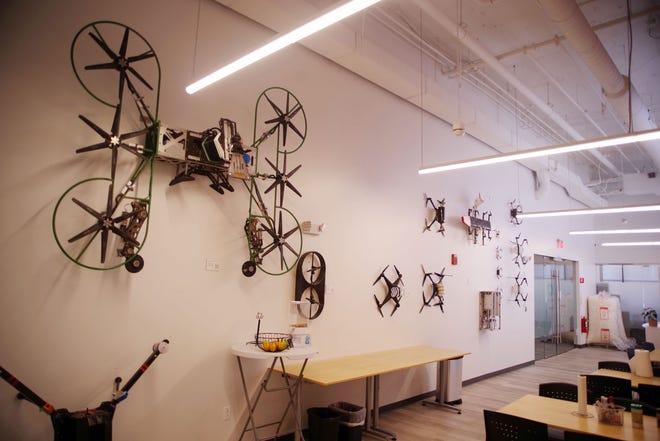 <![endif]>Melendez doesn’t want to limit himself just to aerospace engineering and wants to gain skills in as many areas as he can, like electrical, mechanical and software.
He’s waiting for his first paycheck to come in so he can start working on some side projects this summer. He wants to build a first-person view drone, which is common in the military, and also buy a 3D printer, so he can create his own parts, rather than ordering them online.
He wants to “have that perpetual growth of, I get to be here and grow, … and, even on the weekends, when I’m not allowed to work, I get to grow a little bit more as well," he said.
Melendez is heading to Cape Cod Community College this fall, where he’s going to do a program in Aviation Maintenance Technology. Once he has that certificate, he aims to find a job that will pay for him to get an engineering degree.
“I’m not some rich guy,” he said. “I can’t just pay out my debt, and I don’t want to be drowning in it.”
David J. Ferreira
CommunicationsCoordinator
Massachusetts Association of Vocational Administrators (MAVA)
Davidferreira
508-951-2123