

MAVA Colleagues,
We are pleased to share this piece from today’s “Enterprise”.
David
What new Brockton High will cost taxpayers and what they’ll get
Jacob Posner The Enterprise July 13, 2026, 5:09 a.m. ET
- The new building would expand career technical education programs, including electrical, HVAC, and engineering.
- Residents will likely vote in early 2027 on whether to fund the city’s portion of the roughly $800 million project.
Building a new Brockton High School is estimated to cost local homeowners an average of $188 per year over 10 years, consultant Kevin Sullivan said during a recent community forum.
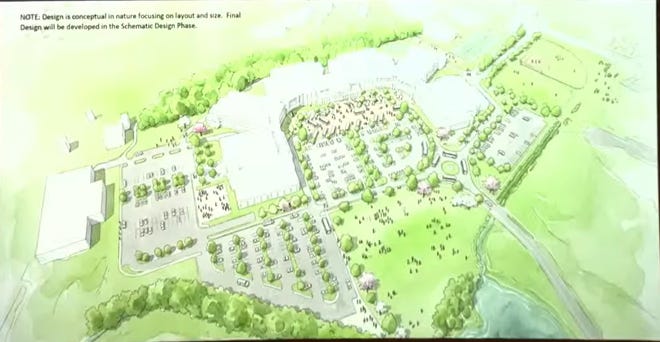
Principal Kevin McCaskill described what residents are paying for.
He said of the design, "It looks like two arms, ready to embrace you … as opposed to what we got currently, looking like a correctional center."
Residents will vote on whether they’ll pay the city’s share of the roughly $800 million project — the state reimburses an estimated 50% to 60% of the cost, according to Sullivan — in January or February of next year.
 ‘Saved the school:’ Brockton High principal turned the school around. How did he pull it off?
‘True opportunity for our students’
The new building would provide significantly more space for career technical education (CTE) programs, which McCaskill called during the June 25 forum "probably one of the most important components of modern-day education.”
The high school currently offers five programs, and McCaskill hopes to add new ones including electrical, HVAC, facilities management, and engineering and robotics. The new school’s trade hall would provide space for mock construction of a small house, he added.
“Now we are providing true opportunity for our students," he said. "And no longer will education be just to get a diploma.”
Residents pay extra until ‘window of opportunity’
Though Brockton property owners will only see higher taxes for 10 years, the city will be paying off debt for the massive project for decades to come, according to the project team.
That’s because the city can take advantage of a "window of opportunity," Sullivan said. By 2037, Brockton will have paid off a large amount of debt related to pensions, which means, after that year, the rest of the money owed for the school project would fall under the city’s debt limit.
Put differently, after 2037, the usual tax rate would be sufficient to absorb the high school debt, meaning residents would no longer need to pay additional taxes each year.
Sullivan added that, after 2037, the city will still be able to take on additional debt for future capital-intensive projects.
The $188 average tax bill includes wildly different numbers each year. Here’s how much larger tax bills will be for the average homeowner each year for 10 years.
- 2027- $8.24
- 2028- $8.24
- 2029- $28
- 2030- $86
- 2031- $170
- 2032- $276
- 2033-2035- $322
- 2036- $335
Sullivan mentioned that the new Brockton High School would cost significantly less than a school building project in East Bridgewater that he recently worked on, where homeowners agreed to pay an additional $900 per year, on average, for 25 years.
Other new features
The new high school would also include a restaurant run by students, school-based health center, more green space, new outdoor athletics spaces and a media center — made up of lecture halls, a small auditorium, technology information center, makerspace, computer labs, an e-sports lab and spaces for technology-related CTE programs.
An audience member spoke up at the end of the forum about the importance of CTE, also called vocational education, in his life.
Steven Barry, business manager for an electrician’s union, said he grew up in Brockton and was able to escape poverty in part because he went to Southeastern Regional Vocational Technical High School.
“I know, for sure, that [if] the opportunity to have a vocational education at Brockton High was available, I probably wouldn’t have gone to Southeastern," he said.
David J. Ferreira
CommunicationsCoordinator
Massachusetts Association of Vocational Administrators (MAVA)
Davidferreira
508-951-2123