




Colleagues,
We are pleased to share this interesting piece, published last weekend.
David
As Mass. moves toward banning cellphones in schools, vocational students feel the pinch
- Published: May. 02, 2026, 5:55 a.m.
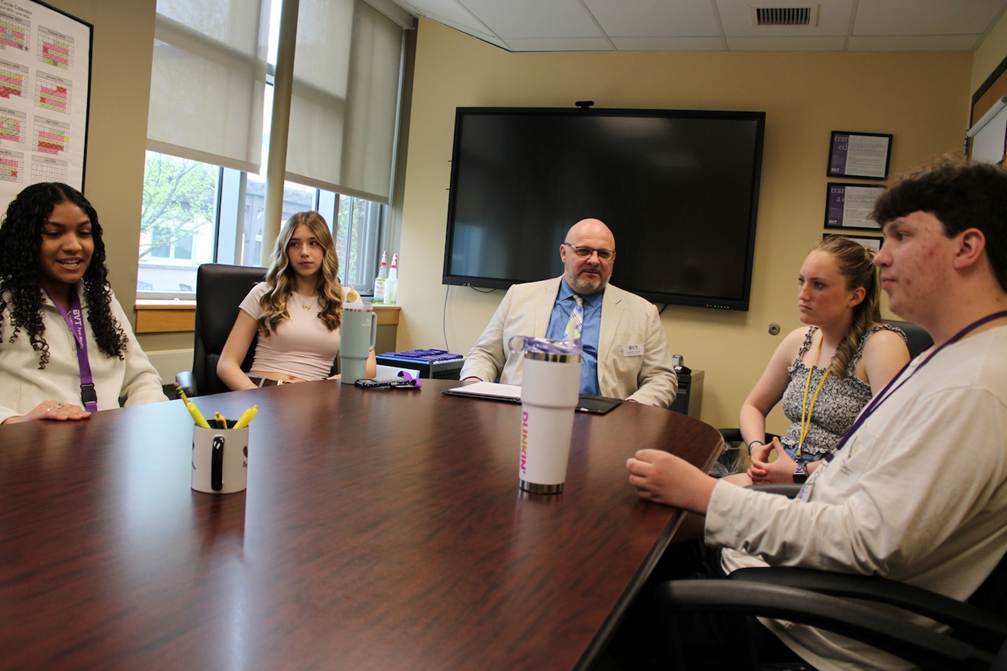 From left, students Maria DeOliveira, Chloe Burke, Blackstone Valley Tech Superintendent-Director Anthony Steele, and students Alexis Maeder and Zack Pelletier discuss the school’s cellphone policy, and how it could be affected by a proposed statewide ban.
By Maureen Sullivan
Like a growing number of public-school students throughout Massachusetts, vocational-technical students have to keep their cellphones “off and away” or tucked away in a locker or Yondr pouch.
However, these students argue a cellphone is more than talk and text — it helps them prepare for the working world.
Several students from Blackstone Valley Tech in Upton recently discussed how they use their cellphones, and how that use could change should a bill currently in the state Legislature become law.
The proposed “bell to bell” ban would require public school districts to have a policy prohibiting student use of personal electronic devices during the school day, as well as school-sponsored activities during the school day.
Supporters, including superintendents and local legislators, laud the potential to reduce distractions and keep students focused on learning.
“We are currently in our second year of using Yondr pouches, and I can confidently say the implementation is going as well as could be expected,” said Kyle Brenner, superintendent-director for Bay Path Vocational Technical High School in Charlton. “The ongoing challenge is ensuring that all students adhere to putting the electronic devices (cellphones, smart watches/glasses, and ear pods) in their pouch each morning. However, we have observed a marked difference in the school environment; cellphones are essentially absent from hallways and common areas throughout the building.”
However, the Blackstone Valley Tech students said they were concerned that the proposed bill would allow little leeway when it comes to vocational-technical education
 “No phones means more pressure on students,” said Maria DeOliveira, a junior from Milford in the electrical program. “Technology has taken over. After high school, employers won’t say ‘give me your phone.’”
“It comes down to trust,” said Alexis Maeder, a sophomore from Northbridge who is studying biotechnology. “We’re a training workforce site.”
“Kids should have that chance to build that trust,” said Zack Pelletier, a junior from Uxbridge who is in the paint/design program. “In the real world, you do what you want.”
Blackstone Valley Tech’s current policy is “off and away” – devices off during the school day, except on teacher request. “Students do for the most part abide by that,” said Superintendent-Director Anthony Steele.
Steele cited the importance of teaching “responsible use” of cellphones, and how cellphones have become an integral part of the school — obtaining a hall pass with a QR code on a mobile device; making an appointment with a counselor via an app; and how students store videos and photos for their portfolios. “In my shop, I take lots of photos,” said Hunter Savard, a sophomore from Blackstone who is studying engineering and robotics.
 But the students do support the intention of the proposed ban.
“In my shop, there’s a sign – ‘We want you, not the phone.’ You get more time to talk with friends,” said DeOliveira.
The students also brought up two situations should the “bell to bell” pass become law — what could happen during an emergency situation, and enforcement on students who defy the ban.
DeOliveira recalled an emergency incident in middle school. She did not have her phone and was unable to contact her mother until three hours after the incident.
Blackstone Valley Tech conducts a “run drill,” where students scatter during an emergency situation. Under those circumstances, Chloe Burke, a junior from Mendon in the design/media program, said she’d like to have her phone with her.
As for those students who insist on using their phones despite the ban. “It’ll be an opportunity for kids to get sneakier,” said Pelletier. “They will find a way around it.”
State Sen. Ryan Fattman has similar misgivings about the bill.
“Cellphones are instrumental in modern society, and an outright cellphone ban in schools does not serve students well or appropriately teach students how and when to use phones maturely in an academic environment,” said Fattman, who was one of two senators voting against the bill in July 2025.
“The Senate’s cellphone ban legislation also creates a blanket policy for all schools rather than allowing the school districts to create policies based on their own community’s needs. In fact, many schools in my district have integrated technology that requires students to use their mobile devices, such as in-class surveys, which enhance participation and create a more collaborative learning environment in the classroom. Lastly, this legislation fails to consider all facets of cellphone use in schools such as families communicating during the school day especially during a public safety or family emergency,” he added.
Should the proposed bill become law, Steele said, “Whatever it turns out to be, we will make the most of it.”
 Yondr pouches for Bay Path
Instead of having phones “off and away,” Bay Path uses Yondr pouches, which feature a magnetic lock controlled by school staff. At the start of the school day, students place the cellphones in these pouches; the phones remain locked until the end of the school day.
“The impact on our school culture has been tangible. We have seen a significant increase in student engagement, with students making authentic, in-person connections with their peers during passing times and in the lunchroom,” said Brenner. “Furthermore, many of our staff members have shared positive feedback regarding the dramatic reduction in interruptions to instructional time in both our academic classrooms and our technical shops. The policy has allowed us to reclaim valuable time for teaching and learning,” he added.
Where to plans to ban cellphones in schools stand now?
As part of the proposed bill, districts must make accommodations and exceptions as necessary, including for students with IEPs or disabilities that require the use of personal electronic devices; documented medical needs, including to treat or monitor a health condition; language access and translation needs, as authorized by the superintendent or a designee. Accommodations and exceptions must also be made in the event of an emergency.
The state Department of Elementary and Secondary Education would have to provide districts with guidance, recommendations and a model policy to implement the restrictions.
It also creates a pilot program run by DESE to administer for 10 districts to render students’ personal electronic devices inoperable on school grounds during the school day, according to an analysis of the bill.
Schools are required to file their policies annually to DESE no later than Sept. 1.
The cellphone ban proposal is part of a larger bill that would also restrict social media access to children under 14. Following passage in the Senate, the measure passed the House on April 8. The bill has returned to the Senate for further consideration.
Governor Maura Healey has also submitted her own proposal on a school cellphone ban.
“Regarding the legislative discussions at the State House, we do not anticipate any issues or significant changes to our current policy should the legislation pass,” said Brenner. “Because we have already successfully established a ‘bell-to-bell’ culture with the Yondr system, we feel well-positioned to align with any state-mandated requirements. We believe our current approach already meets the spirit and intent of creating a focused, distraction-free environment for our students.”